The Two-Week Wait When You're Scared of Birth: Relieved by Your Period, Then Dreading Trying Again
If you're trying to conceive but feel relieved when your period arrives — then guilty for feeling relieved — you're caught in a cycle that almost nobody talks about. It doesn't mean you don't want a baby. When you're frightened of pregnancy and birth, your nervous system treats each negative test as a reprieve, even while your heart is breaking a little. This article explains the relief-then-dread loop, why it can trap you for years, and how to get unstuck — from a perinatal therapist who works with exactly this.
⏱️ Read time: 7 minutes — or jump to what you need most:
Your period arrives. And before the disappointment lands, there's something else.
Relief.
A quiet, involuntary exhale. Not this month. You don't have to face it yet. Safe for a little longer.
And then — almost immediately — the guilt. Because you want this baby. You've wanted it for months, maybe years. So what is wrong with you that a part of you is relieved not to be pregnant? What kind of woman feels that?
If you've been living this every cycle, I want you to know two things straight away. First, you are not the only one — this is a recognised pattern in women who fear pregnancy and birth, even though almost nobody talks about it. Second, the relief is not what you think it means. It is not evidence that you don't want a baby. It's evidence that you're frightened. And those are completely different things.

The cycle nobody names
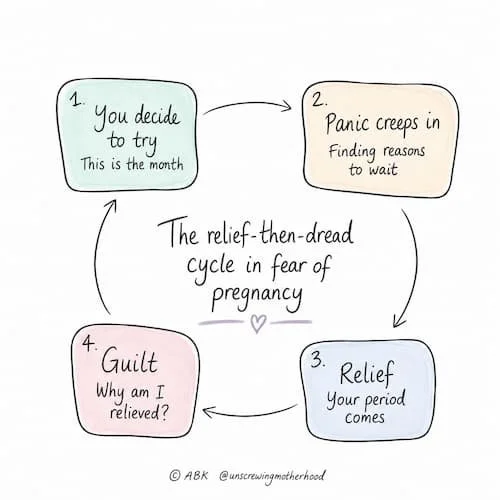
Here's how it usually goes.
At the start of the cycle, you decide. This is the month. You want the baby, you're going to do it, you've talked yourself into it.
Then, as the fertile window approaches, the panic creeps in. You find reasons. The timing isn't quite right. You're too stressed this month. Work is mad. You'll start properly next cycle. Or you go through the motions but a part of you is braced the entire time, half-hoping it won't happen.
Then you wait. The two-week wait, except for you it's not hopeful anticipation — it's dread. Some part of you is quietly praying for the thing you say you want not to happen.
Then your period comes. Relief floods in. And then the guilt crashes down on top of it.
And then, a week or two later, you steel yourself and decide: this is the month. And it all begins again.
If you recognise this loop — the deciding, the sabotaging, the relief, the guilt, the deciding again — you are not broken and you are not confused about what you want. You're caught in a fear cycle. And naming it is the first step to breaking it.
Why you feel relieved when you want this so badly
The relief confuses women more than anything else, so let's take it apart.
When you're frightened of pregnancy and birth — whether that's a diagnosed tokophobia or "just" a deep, persistent fear — your nervous system has quietly filed pregnancy under threat. Not consciously. You didn't choose it. But underneath your conscious wanting, your survival brain treats getting pregnant as walking towards danger.
So when your period arrives and you're not pregnant, your nervous system does exactly what it's designed to do when a threat is avoided: it releases the tension. It exhales. That exhale is the relief you feel. It is automatic, bodily, and it has nothing to do with whether you want a child.
This is the crucial thing to understand: the wanting and the relief are not in competition about whether you want a baby. They're operating on completely different levels. The wanting is you — your values, your hopes, the life you want to build. The relief is your threat system reacting to a perceived danger being postponed. Both are real. Neither cancels the other out.
You can want a baby with your whole heart and still feel your body sag with relief when you're not pregnant. That's not a contradiction. That's fear and desire living in the same person at the same time.
How "trying without trying" traps you for years
This cycle has a way of stretching out far longer than anyone expects. Eighteen months. Two years. Three. "Trying" the whole time — but not really.
From the outside, and even to your partner, it can look like you're trying to conceive and it's just not happening. Inside, you know the truth is more complicated. You're finding reasons to wait. You're mistiming it, maybe not entirely by accident. You're relieved each month it doesn't work. You're the obstacle, and you know it, and that knowledge is its own particular kind of painful.
Meanwhile, real things are happening. Time is passing. Your fertility, or your partner's, might genuinely be a factor as the years go by — which adds a whole new fear on top of the original one, a horrible squeeze between "I'm terrified to get pregnant" and "I'm terrified I'll leave it too late." Your relationship may be straining. Your partner may be confused, hurt, or quietly grieving a family that isn't arriving, without understanding why.
None of this is because you don't want a baby. It's because the fear has never actually been addressed — so every month you're asking yourself to walk toward the thing you're most frightened of, with nothing to help you do it except willpower. And willpower doesn't beat a threat response. It never has.
This is exactly why the cycle can go on so long. And exactly why it usually doesn't break on its own.
When it's fear, not ambivalence
It's worth being honest here, because there's an important distinction.
Sometimes not being sure about having a baby is genuine ambivalence — a real, valid uncertainty about whether motherhood is the right path for you. That deserves space and honesty, not fixing. If that's what's going on, no therapy should push you toward a baby you're not sure you want.
But fear is different from ambivalence, and it usually feels different from the inside.
Ambivalence tends to be quiet and thoughtful. When you imagine a future without children, it feels like a genuine possibility you could make peace with. The uncertainty is about the wanting.
Fear tends to be loud and physical. The wanting isn't in question — you know you want a baby, sometimes desperately. What shuts you down is the pregnancy and birth, the physical reality of it, and your body reacts with dread rather than your mind reacting with doubt. When you imagine a future without children, it doesn't feel like peace — it feels like loss.
If it's ambivalence, you need space to work out what you want. If it's fear — if you know what you want and the fear is what's in the way — that's the kind of thing that responds to therapy, and often responds well.
How to get unstuck
The way out of this cycle isn't more willpower. It's addressing the fear underneath it — ideally before another year goes by.
Trauma-focused CBT works on the beliefs feeding the fear — "birth will destroy me," "I can't cope with pregnancy," "I'll lose all control" — and on the avoidance patterns that keep the cycle spinning. It helps you understand why your nervous system reacts the way it does, and gradually teaches it that the threat isn't the certainty it feels like.
EMDR therapy is often especially useful here, and as a qualified EMDR therapist it's some of the work I find most rewarding with these clients. If your fear was built on frightening birth stories or images you absorbed over the years, EMDR can reprocess those so they stop feeling like a prophecy about your own body. And its future-template work helps your brain rehearse pregnancy and birth as something you could actually get through — replacing the braced dread with a genuine felt sense of "I can handle this." Both are the kind of shifts that change what happens the next time you're deciding whether "this is the month.
Both are recommended by NICE as evidence-based psychological treatments. And the best part, for this particular cycle, is that you can do this work now — before you're pregnant, without a clock running — so that trying to conceive stops feeling like walking toward something terrifying.
I've written more about the fear itself, and where it comes from, here: Want a Baby but Terrified of Pregnancy and Birth? You're Not Broken and about treatment more broadly here: Tokophobia Treatment: How to Overcome Your Fear of Childbirth.
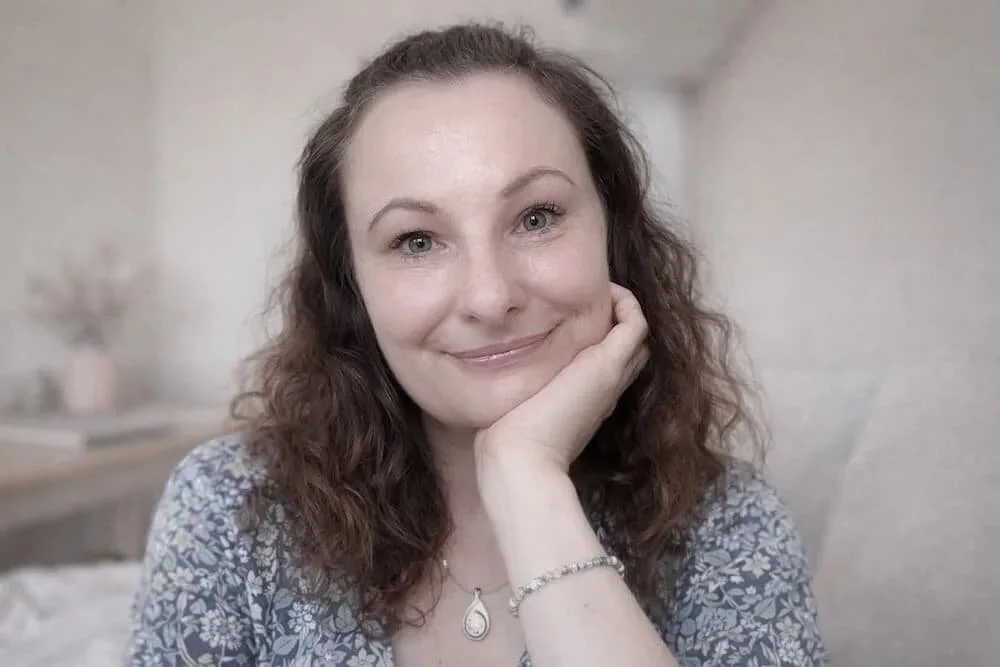
Hi, I’m Aleksandra!
I'm a BABCP-accredited CBT therapist, qualified EMDR therapist, and registered mental health nurse with over ten years of NHS experience, specialising in tokophobia, birth trauma, and pregnancy after loss.
I work with women across the UK, EU and internationally — including women who want a baby desperately but are so frightened of pregnancy and birth that they can't make themselves try. Women caught in the relief-then-dread loop, month after month, feeling like something is wrong with them. There isn't. And you don't have to stay stuck here.
You don't have to keep starting over every month.
The relief you feel when your period comes isn't a sign you don't want this. It's a sign you're frightened — and fear can be worked with in a way that willpower can't.
Reaching out doesn't commit you to anything — not a pregnancy, not a timeline, not a decision. It just means finally addressing the fear that's been running the cycle.
And if part of you has just felt understood and is already planning to think about it next month — notice that. That's the same postponement that's kept the loop going. Sending one message isn't a step toward the thing you're scared of. It's a step toward not being stuck.
If any of this has felt like reading your own thoughts — reach out.
You can book a free 20-minute conversation— a real conversation about what's been happening and whether the way I work sounds right for you. No pressure and no obligation.
Or email me instead if a call feels like too much right now. Just a few lines about where you are is enough. There's no wrong way to start.
Sessions are £130 • Online across UK, EU and internationally • Weekly sessions available
FAQ: Feeling relieved when your period comes while trying to conceive
-
Because the relief isn't about not wanting a baby — it's your nervous system exhaling because something it perceives as a threat has been postponed. If you're frightened of pregnancy and birth, your survival brain treats getting pregnant as walking toward danger, so a negative test brings automatic relief even while you're consciously disappointed. The wanting and the relief operate on completely different levels. Both are real.
-
No. Relief at a negative test when you're afraid of pregnancy is a fear response, not a sign of your true desire. Many women who want children deeply feel this relief because part of them is terrified of the pregnancy and birth itself. It doesn't mean you shouldn't be a mother — it means fear is making the decision harder than the wanting alone would.
-
Yes — it's common in women who fear pregnancy or birth. Finding reasons to wait, mistiming the fertile window, half-hoping it won't work — these are avoidance behaviours driven by fear, not signs of ambivalence. It's your nervous system protecting you from a perceived threat. Understanding this is usually what starts to break the pattern.
-
Fear tends to be loud and physical — you know you want a baby, but the pregnancy and birth fill you with dread, and a childless future feels like loss. Ambivalence tends to be quieter and more thoughtful — the uncertainty is about whether you want children at all, and a childless future feels like a genuine possibility you could accept. Fear responds well to therapy; ambivalence needs space to explore what you actually want.
-
Yes — and for this cycle it's often the ideal time. Working through the fear before you conceive means no time pressure and no escalating dread of an approaching birth. It changes what happens the next time you're deciding whether to try. Many women find addressing the fear first is exactly what finally lets them get pregnant.
-
Yes. EMDR can reprocess "borrowed" trauma — the frightening birth stories and images you've absorbed over the years — so they stop feeling like a prophecy about your own body. Its future-template protocols also help your brain rehearse pregnancy and birth as something survivable. As a qualified EMDR therapist, I use it frequently with women who fear birth despite never having given birth.
-
Often years, if the underlying fear is never addressed — because willpower alone can't override a threat response, so each month you're asking yourself to do something your nervous system is braced against. The cycle rarely breaks on its own. But once the fear is worked through, trying to conceive stops feeling like walking toward danger, and the loop can finally end.
References & Resources:
Tommy's: Fear of Childbirth (Tokophobia) — information and support
Fertility Network UK — support around trying to conceive, including the emotional side
PANDAS Foundation — perinatal mental health support, helpline 0808 196 5026
Mind: Anxiety and panic attacks — information and support
NICE NG116 — Post-traumatic stress disorder — clinical guidelines underpinning trauma treatment
EMDR Association UK — about EMDR and the evidence base
If you're struggling to cope, having thoughts of self-harm, or feeling unable to keep going, please reach out to your GP, call Samaritans on 116 123, or go to A&E. You deserve support right now.
Let’s connect:Disclaimer:
The information provided in this article is for educational and informational purposes only. It is not intended to be a substitute for professional medical or mental health advice, diagnosis, or treatment. Always seek the guidance of your healthcare provider, mental health professional, or other qualified health provider with any questions you may have regarding your pregnancy or mental health.