Pregnant after loss and finding that most affirmations make you feel worse, not better? You're not doing them wrong. Many popular affirmations promise things nobody can promise you. This post shares gentler ones you can actually believe, and how to use them when fear is loud.
Read time: 7 minutes
Another trip to the bathroom. Another check for blood.
You count down to the next scan and hold your breath until you get there. Someone says "try to stay positive", and you smile and nod. Inside, you're bracing for the worst, because last time, staying positive didn't protect you.
So when someone hands you a list of affirmations that says "everything will be fine", it can feel almost cruel.
Here's what I most want you to know. This isn't you being negative. It's your nervous system remembering loss. And affirmations can still help, as long as they're honest with you.
Why so many affirmations feel like a lie
Most affirmations you'll find online were written for people who haven't lost a baby.
"My body knows what to do." "I trust my pregnancy." "Everything is going to be fine."
If you've had a miscarriage, a stillbirth or a TFMR, your body may have taught you something very different. So when you say these words, a voice inside answers straight back: but you don't know that.
And that voice isn't wrong. Nobody can promise you how this pregnancy will end. Not your midwife, not your partner, not a sticky note on the mirror.
When an affirmation makes a promise your experience can't believe, it doesn't calm the fear. It argues with it. And arguing with fear usually makes it louder.
That's why the affirmations in this post don't promise anything about the outcome. They speak to what's true right now: that you're scared, that you're coping, and that you deserve kindness while you wait.

What the research really says
There's an interesting study that backs this up. In 2009, psychologists at the University of Waterloo asked people to repeat the phrase "I am a lovable person". People who already felt good about themselves felt slightly better. But people with low self-esteem felt worse afterwards. When those same people were allowed to acknowledge their difficult thoughts alongside the positive ones, their mood improved (Wood, Perunovic and Lee, 2009).
In other words, an affirmation that's too far from how you feel can backfire. An affirmation that makes room for the fear is more likely to help.
There's also good research on a different kind of affirmation, where you remind yourself of what matters most to you, like the people you love or the kind of person you want to be. One brain-imaging study found that this kind of reflection activated areas linked to self-worth and reward (Cascio and colleagues, 2016).
So the affirmations most likely to help you are honest, kind and connected to what you care about. Not the ones that tell you everything will be fine.
How to choose words you can believe
Here's a simple test. Say the affirmation out loud. Then notice what your mind says back.
If it answers "liar" or "you don't know that", the words are too far from where you are. Soften them until the argument goes quiet.
The affirmations that tend to work after loss do one of three things:
They name the fear, rather than fighting it. "It makes sense that I'm scared."
They focus on right now, not on the ending. "Right now, I'm getting through this hour."
They offer kindness, not perfection. "I'm doing my best, and that's enough for today."
A little trick that helps many women: add "even though" or "and". Not "I am calm", but "I'm frightened, and I'm still here." Both parts can be true at once.
Gentle affirmations for pregnancy after loss
These are suggestions, not rules. Take what fits, change the words so they sound like you, and leave the rest.
When the fear spikes
It makes sense that I'm scared. My body remembers.
This feeling is fear, not a prediction.
I don't have to know how this ends to get through today.
I can feel afraid and still breathe.
When you feel guilty for not "enjoying" it
I don't have to feel happy to love this baby.
There's no right way to feel in a pregnancy after loss.
Protecting my heart is not the same as not caring.
When you want to hope, but hope feels risky
I'm allowed to hope, even though I'm scared.
Today, I'm caring for this baby the best way I can.
Small moments of calm still count.
For the baby you lost
Hoping for this baby doesn't mean forgetting the one I lost.
I can grieve and hope at the same time.
On scan days
I only have to get through the next hour.
My fear is allowed in the waiting room too.
I'm allowed to ask for what I need today.
Notice what's missing. None of these say "everything will be fine" or "nothing will go wrong". That's on purpose. Honest words are easier to lean on when you're frightened.
How to use them
Affirmations work best when they're small, regular and easy to reach. You don't need a whole list. One or two that feel true are plenty.
In the morning, choose one for the day. Say it once while the kettle boils, or write it on your hand.
On scan days, keep it somewhere you'll see it in the waiting room: your phone lock screen, a note in your bag.
When panic hits, pair your affirmation with slow breathing. Breathe in gently for 4, then out for 6. A longer out-breath helps your body settle. Say your words on the out-breath.
At bedtime, when the "what ifs" get loudest, try a quieter one: "I've got through today. That's enough."
Some women like to keep a small notebook, writing down the affirmation they used each day and how it felt. Over a few weeks, you may notice the words start to feel a little more like yours.
After miscarriage, before you're pregnant again
Maybe you're not pregnant right now. Maybe you're grieving, or trying to decide whether you can face trying again. Affirmations can help here too, as long as they leave room for the grief.
My grief shows how much this baby mattered.
I don't have to be "ready" today.
I can take the next step when it feels possible, not when other people expect.
Being scared to try again makes sense after what I've been through.
If the fear of trying again feels like it's taking over, you might find this helpful: Too Scared to Try for Another Baby After Miscarriage.
When affirmations aren't enough
Sometimes even the gentlest words can't touch the fear. You might be checking constantly, unable to sleep before scans, or having flashbacks to your loss. That doesn't mean you're failing. It means the fear needs more than words.
Pregnancy after loss is one of the areas I specialise in. With CBT, we look at the cycle that keeps the fear going: the checking, the bracing, the "what ifs". Then, gently and at your pace, we build ways to loosen it. With EMDR, we can work on the memories of your loss, so they stop feeling as raw and stop flooding every scan and twinge.
I'm a BABCP-accredited CBT therapist and a member of EMDR Association UK, working towards accreditation. I often blend the two.
You don't have to wait until this pregnancy is "safe" to get support. For many women, the best time is now.
Ready to talk?
If you're pregnant after loss and the fear is taking up more of your days than you'd like, you don't have to carry it alone.
If you'd like more support, I offer online therapy across the UK, the EU and internationally. Sessions are £130, with weekly appointments available. You can book a free 20-minute conversation or email me. Getting in touch doesn't commit you to anything.
You're allowed to be scared and hopeful at the same time. And you're allowed to have help with both.
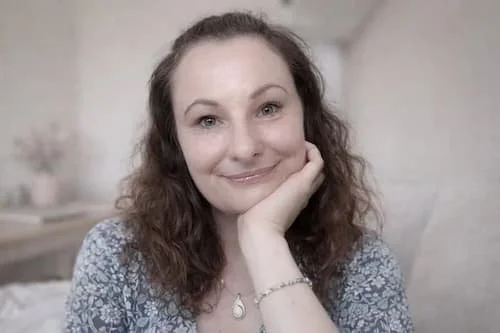
Hi, I'm Aleksandra!
I'm a BABCP-accredited CBT therapist and a member of EMDR Association UK, working towards accreditation. I specialise in pregnancy after loss, birth trauma, fear of pregnancy and birth, and perinatal anxiety and OCD. I've spent around ten years in NHS Talking Therapies as a therapist and clinical supervisor. More about me.
FAQ: Affirmations for pregnancy after loss
-
They can, when the words feel believable. Research suggests positive statements that feel too far from how you feel can actually make some people feel worse. Gentle, honest affirmations that make room for fear are more likely to help, especially alongside other support.
-
That's very common after loss, and it's a sign the words are promising something your experience can't believe yet. Try something closer to the truth, like "Right now, I'm getting through this moment" or "It makes sense that I'm scared."
-
Then they're probably not the right words for you yet. Change them until your mind stops arguing back. Using "and" often helps: "I'm frightened, and I'm still here."
-
Yes. In the weeks and months after a loss, affirmations that honour your grief tend to help most, such as "My grief shows how much this baby mattered." There's a short list in the section above.
-
No. They can be a helpful support, but they don't replace professional help when fear or grief feels overwhelming. Many women find it helps to use both.
Related reading
7 Things I Tell My Clients Who Are Pregnant Again After Miscarriage
Scan Anxiety After Miscarriage: Why You Dread Every Scan, and What Actually Helps
Anxiety in Pregnancy After Miscarriage: CBT and EMDR Therapy That Actually Helps
Pregnancy After Miscarriage Anxiety: You're Not Overreacting
Miscarriage Grief and Trauma: Why It Stays, and What Actually Helps
Pregnant After Loss but Too Terrified to Feel Joy: Surviving the Holidays
References & Resources
Cascio CN, O'Donnell MB, Tinney FJ, Lieberman MD, Taylor SE, Strecher VJ, Falk EB (2016). Self-affirmation activates brain systems associated with self-related processing and reward and is reinforced by future orientation. Social Cognitive and Affective Neuroscience. Supplementary material
Support after loss
The Miscarriage Association: support and information, including on pregnancy after miscarriage
Tommy's: information and support for pregnancy after loss
Sands: support after stillbirth and neonatal death
Petals: counselling after baby loss
If you need support right now: Samaritans are free and open 24 hours a day on 116 123. If you're worried about your pregnancy, contact your maternity unit or call NHS 111. In an emergency, call 999.
Let’s connect:Disclaimer:
The information provided in this article is for educational and informational purposes only. It is not intended to be a substitute for professional medical or mental health advice, diagnosis, or treatment. Always seek the guidance of your healthcare provider, mental health professional, or other qualified health provider with any questions you may have regarding your pregnancy or mental health.