Why Time Isn't Healing Your Baby Loss - And What Actually Can?
⏱️ Quick Read (2 minutes)
You avoid the baby aisle in Sainsbury's. Not because it makes you sad (though it does), but because you know you'll be flooded with images and sensations too difficult to contain in the middle of a supermarket. The due date came and went. Time is passing. But the flashbacks haven't stopped.
If you've lost a baby—through miscarriage, stillbirth, or termination for medical reasons (TFMR)—you might be experiencing:
Flashbacks that won't stop - the scan room, the blood, the moment you knew
Physical pain when you see pregnant friends or pass the baby clothes section
Grief that feels stuck - months or years have passed, but the raw pain hasn't shifted
A sense that something's blocking you from healing - you want to grieve, but you can't seem to access it
What if what you're experiencing isn't actually grief—but unprocessed trauma that's blocking your ability to grieve?
This article explains:
Why baby loss is traumatic (not just sad)
What EMDR therapy is and how it processes trauma
How EMDR specifically helps with pregnancy loss
What EMDR treatment for baby loss actually looks like
Evidence that it works
You're Not Just Grieving -You're Traumatised
The memories keep coming back. Not as gentle remembering, but as flooding—sudden, overwhelming, physical. The scan room. The blood. The silence where there should have been a heartbeat. The moment you knew.
And alongside the grief (which is there, heavy and constant), there's something else. Something that makes you physically uncomfortable around pregnant friends. Certain smells trigger panic. You avoid hospitals, or toilets, or specific rooms in your house. Time hasn't helped the way people said it would.
Here's what most people don't understand: What you're experiencing might not be grief that needs more time. It might be unprocessed trauma that's actually blocking your grief.
And there's a specific type of therapy—EMDR—that can help you process that trauma so you can finally, properly grieve.
Why Baby Loss Is Trauma (Not Just Sadness)
It Goes Against the Natural Order
When babies die before us—at any gestation, for any reason—it violates something fundamental. Children aren't supposed to die before their parents. Pregnancies are supposed to end with babies. The natural order of the world feels broken, and that shattering is traumatic in itself.
You Lose Part of Yourself
Your baby wasn't separate from you. For mothers, they were inside you—your body nourished them, carried them, knew them. When they die, it feels like losing part of yourself. Not metaphorically. Literally. A piece of who you were is gone.
For partners, the baby was part of your imagined future, your family, your identity as a parent. That loss leaves a wound.
Trauma Means "Wound"
The word "trauma" comes from Greek, meaning wound. Just as physical objects can pierce our skin (and the sharper the object and greater the force, the deeper the damage), difficult life experiences leave internal wounds.
Baby loss leaves a deep wound. It's not a surface cut that heals on its own with time.
Trauma ≠ PTSD (But They're Related)
Important distinction:
Trauma = the event itself (what happened to you)
PTSD = the symptoms you experience afterwards (flashbacks, hypervigilance, avoidance, intrusive memories)
Research shows that between 8-39% of women experience clinically significant PTSD symptoms following miscarriage or ectopic pregnancy, with rates varying depending on the study methodology and timing of assessment. In the UK, 1 in 4 families experience pregnancy or baby loss. Yet most receive no trauma-specific support.
When I talk about "trauma" in this article, I'm referring to the experience where the memory of your loss is still raw, unprocessed, and actively affecting you in the present—through flashbacks, intrusive memories, or overwhelming physical sensations when triggered.
What Is EMDR Therapy?
EMDR stands for Eye Movement Desensitization and Reprocessing. It's a type of therapy specifically designed to process trauma.
When Do You Need Trauma Processing?
When what happened in the past still has an effect on you here and now, impacting your daily functioning. When time passing hasn't helped. When other approaches haven't shifted the stuck-ness.
Your Brain's Natural Healing Ability
Here's something most people don't know: Your brain has a natural processing system, similar to how your physical body heals.
When you cut your finger, your body immediately starts producing cells to heal the wound. You don't have to consciously tell it to heal—it just does.
EMDR theory proposes that your brain has a similar processing system called Adaptive Information Processing (AIP). While AIP is a working model rather than proven neuroscience, it provides a useful framework for understanding how EMDR might work. This is the system thought to be responsible for processing difficulties you encounter during the day so you don't keep replaying them:
Someone cuts you off while driving - nearly causes an accident, your heart races. A few days later, you've forgotten about it.
You have an argument with your partner - it's resolved now, and you can barely remember what you argued about.
A stressful conversation with your boss - you wake up the next day and think, "Actually, that wasn't as bad as it felt in the moment."
The reason you don't overthink these situations—why you were able to "put them to bed"—is thought to be this natural processing system working.
What AIP Theory Proposes
According to this model, your brain processes experiences and stores them in long-term memory as past events that are fully resolved. The memory stays, but it's filed away as something that happened in the past, not something threatening you right now.
When Trauma Overwhelms Natural Processing
Those minor examples above are like small cuts that heal themselves.
But baby loss is a deep wound. Because of how overwhelming the trauma was in that moment, this natural processing system didn't have a chance to work through it fully. The wound is too big, too jagged, too deep.
So your brain keeps trying to process it—that's what flashbacks and intrusive memories are. Your brain bringing the moment back to your awareness, attempting to digest it. But every time it tries, the memory still creates very real physical experiences as if the moment is happening right now. And the cycle continues.
We say these memories are stuck between the past and present.
How EMDR Works: Restarting Natural Processing
The EMDR Process
EMDR helps restart that natural processing system. Piece by piece, it processes all those memories (or parts of memories) that are still stored in raw form—still stuck between the past and present.
Here's the key difference: EMDR doesn't require elaborate talking about the trauma like some approaches. Instead, you:
Bring the traumatic memory to your awareness (we guide this carefully)
While holding that memory, you engage in bilateral stimulation - moving your eyes side to side, or tapping alternately on your knees/arms
This bilateral movement allows natural processing to resume
How Bilateral Stimulation Works: The Leading Theory
The most empirically supported explanation is what's sometimes called the "working memory theory."
When you're traumatised and start thinking about the traumatic event, it feels like that memory takes over your entire brain. There's no room for anything else.
Imagine a table piled so high with mess that you can't even see the table surface. That's what trauma memory feels like—it floods you completely.
What EMDR does: When you do bilateral stimulation (eye movements or tapping), it creates competing demands on your working memory. Part of your awareness is on the trauma, but part is following the movement. You can start to see some table surface again.
Over time, you can start putting the messy stuff in order instead of being overwhelmed by it. The memory becomes more organized, less emotionally charged, and integrated with other information you hold.
Additional theories: Some researchers suggest the bilateral stimulation mimics the rapid eye movements that occur during REM sleep—the phase when memories are naturally consolidated. While this theory is often cited, it remains contested in the research literature. What we do know is that EMDR is effective; the exact mechanism is still being studied.
Research Evidence
A 2019 randomized controlled trial found that EMDR significantly reduced childbirth anxiety in pregnant women who had experienced previous stillbirth. Research from 2022 showed that 72% of pregnant women with PTSD diagnoses related to prior childbirth trauma reduced their fear of childbirth with EMDR, compared to 60% in the control group.
EMDR is recommended by NICE guidelines as a treatment for PTSD alongside trauma-focused CBT, with both approaches showing strong evidence for effectiveness in treating post-traumatic stress symptoms.
How EMDR Helps Specifically With Baby Loss
Trauma Blocks Grief
Here's something crucial to understand: What we sometimes take for grieving can actually be a trauma response.
People can be stuck in that cycle for months or years, unable to actually grieve because trauma is blocking access to the grief.
What Healthy Grief Looks Like
Healthy grieving means:
Going through sadness, anger, and eventually some acceptance
Being able to hold both the painful and the joyful memories
Remembering the times when things were still okay—the positive pregnancy tests, the scan where you heard the heartbeat, the names you chose, the plans you made
Integrating the loss into your life story (it's part of you, but it doesn't consume you)
When mothers grieve baby loss without the interference of unprocessed trauma, I see them able to think about the pregnancy without being flooded. They can hold the sadness while also remembering the hope they felt at the beginning. They can think about their baby without panic.
The Bottle and the Cork Analogy
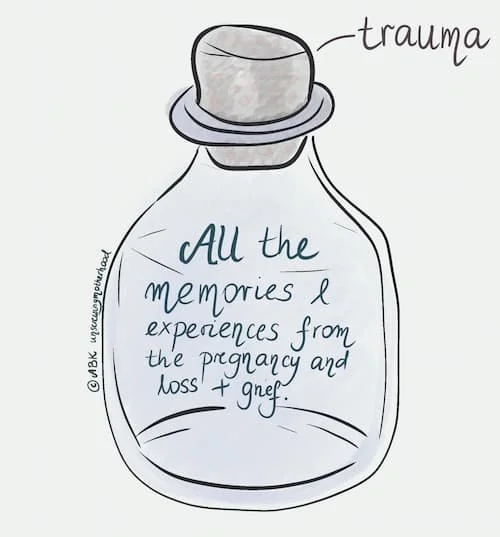
Imagine grief as a bottle.
Inside the bottle are all the memories and experiences of your pregnancy and loss:
The first scan, the second scan, the final scan
The moment you found out you were pregnant
The name you'd chosen
The plans you'd started making
The joy alongside the devastation
Good memories and unbearably painful ones
But you can't access any of it—good or bad—because there's a cork blocking the bottle.
The cork is unprocessed trauma.
The trauma is you re-experiencing, over and over, the worst moments. The natural processing system can't access all those other memories and experiences. It can't accommodate this loss into your whole life story. The cork keeps everything sealed and stuck.
How EMDR Removes the Cork
EMDR allows you to remove the cork and access everything that happened—not just the worst moments. Once the traumatic memories are processed, the bottle opens. You can grieve fully. You can remember your baby in all their complexity. You can hold both the pain and the love.
What EMDR Treatment for Baby Loss Actually Looks Like
Phase 1: Assessment (Sessions 1-2)
We discuss:
Your perinatal story - the pregnancy, the loss, what happened medically
Your wider life story - because trauma doesn't exist in isolation
How the loss is affecting you now - flashbacks, triggers, avoidance, physical symptoms
Phase 2: Preparation (Sessions 2-4)
Before approaching the trauma directly, we build resources:
Coping skills for managing difficult emotions
Grounding strategies to keep you present
Ways to access feelings of resilience and safety (through imagery, body awareness, memories of times you felt strong)
A "container" technique - a way to mentally "put aside" distressing material between sessions so you're not overwhelmed all week
This phase is crucial. We don't rush to the trauma. We make sure you have the internal resources to process it safely.
Phase 3-6: Active Processing
This is where the EMDR reprocessing happens.
What we do:
You think about the traumatic memory (we guide which part to focus on)
You notice:
The image that represents the worst moment
The negative belief about yourself connected to it ("I failed," "I'm broken," "It's my fault")
The physical sensations in your body (tightness in chest, nausea, numbness)
The emotions (terror, despair, rage, emptiness)
While holding all of that, you follow the light bar (eye movements) or tap alternately on your knees
We pause every 20-30 seconds and ask, "What are you noticing now?"
Your brain starts to move through the memory, updating it, connecting it to other information, processing the stuck parts
How it's different:
Some people find they need less verbal recounting with EMDR than with other approaches. You're not analyzing or talking extensively about the trauma. You're allowing your brain to reprocess what's still raw. Trauma doesn't sit in logic or reasoning—that's why reassurance doesn't work, why time passing doesn't always work. Trauma sits in the body.
We process the body sensations. The overwhelming feelings. The images that keep replaying.
What might come up:
Specific memories or images that feel raw
Physical sensations (tightness, pain, numbness)
Connected memories you'd forgotten
Shifts in how you understand what happened
Phase 7: Preparing for the Future
If you're trying to conceive again, or you're pregnant after loss, or you're facing specific triggers (hospital appointments, toilets, certain rooms, baby shops), we can also:
Process those future-oriented fears
Build resources around upcoming situations
Rehearse feeling grounded in scenarios that currently trigger panic
The goal: You can attend hospital appointments, use the toilet, prepare for a baby, go to shops and buy baby items—without overwhelming panic.
How Many Sessions?
This varies enormously. Some people feel significant shifts after 3-4 processing sessions. Others need 10-15 sessions, especially if:
The loss was particularly traumatic (late-term, medical complications, lack of support)
There are multiple losses to process
There's connected trauma from childhood or other life events
When to Consider EMDR for Baby Loss
EMDR might help if:
✅ Months or years have passed since your loss, but the pain feels as raw as day one
✅ You're experiencing flashbacks - sudden, vivid re-experiencing of the worst moments
✅ Certain things trigger panic (not just sadness): hospitals, toilets, specific smells, pregnant friends, baby departments
✅ You avoid things that remind you of your loss to an extent that limits your life
✅ You want to grieve but can't seem to access it - you feel numb or stuck
✅ You're pregnant again and paralyzed by fear, unable to connect with this pregnancy
✅ You feel like grief is blocking you from living, from trying again, from being present with your family
✅ Physical symptoms persist: chest tightness, nausea, pain in your abdomen when thinking about your loss
EMDR Can Be Used:
Immediately after loss (with appropriate preparation)
Months later
Years or even decades later—it's never too late
During a subsequent pregnancy (with careful consideration and medical consultation)
When trying to conceive again

Hi, I’m Aleksandra!
A registered Mental Health Nurse and accredited CBT therapist specialising in perinatal mental health. I work online with pregnant and postnatal women across the UK and EU who are experiencing baby loss, birth trauma, pregnancy anxiety, and tokophobia. With over 10 years of NHS mental health experience and specialist training in Trauma-Focused CBT and EMDR, I help mums move from surviving to actually enjoying their motherhood journey.
You Don't Have to Stay Stuck in the Trauma Loop
For too long, people have told you:
"Time heals"
"You just need to talk about it"
"Have you tried moving on?"
But time doesn't always heal unprocessed trauma. And "moving on" isn't possible when part of you is still stuck in the worst moments.
Here's the truth: Your brain has a natural processing system that got overwhelmed. EMDR can help restart that process. It can remove the cork blocking your grief. It can help you remember your baby without being flooded. It can free you from the trauma loop.
You're not broken. You're traumatised. And trauma is treatable.
If any of this has felt like reading your own experience — reach out.
You can book a free 20-minute conversation — a real conversation about what's been happening and whether the way I work sounds right for you. No pressure and no obligation.
Or email me instead if a call feels like too much right now. Just a few lines about where you are is enough. There's no wrong way to start.
Sessions are £130 • Online across UK, EU and internationally • Weekly sessions available
FAQs About EMDR For Baby Loss
-
Yes, research shows EMDR during pregnancy is safe and effective. Studies demonstrate that pregnant women receiving EMDR experience decreased distress, reduced PTSD symptoms, fewer intrusive thoughts, and increased confidence about their upcoming delivery. However, decisions should be made collaboratively with you, weighing the risks of untreated trauma symptoms against the controlled processing that happens in EMDR sessions.
-
EMDR and trauma-focused CBT are both evidence-based treatments for trauma. Some people find that EMDR requires less detailed verbal recounting of the traumatic event, which can feel more manageable when the memory is very distressing. The bilateral stimulation in EMDR helps facilitate processing in a different way. Both approaches are effective—the right choice depends on your preferences and what feels workable for you.
-
No. EMDR doesn't erase memories. It processes them so they're no longer overwhelming and intrusive. After EMDR, mothers often report being able to remember their baby more fully—the good alongside the painful—without being flooded by trauma. The love remains. The connection remains. But the raw, unprocessed pain shifts.
-
PTSD can be successfully treated many years after the traumatic event. I've worked with mothers processing losses from 5, 10, even 20 years ago. If the trauma is still affecting you now, it's not too late.
-
No. You share what feels necessary for the therapist to understand. During the processing itself, you're not required to describe everything out loud. The bilateral stimulation allows processing to happen without extensive verbal recounting.
-
This varies. Uncomplicated single-event trauma might resolve in 3-6 processing sessions. More complex situations (multiple losses, additional trauma, significant medical complications) might need 10-15+ sessions. We work at your pace.
-
That's completely valid. The preparation phase (Phase 2) can last as long as you need. We only move to processing when you feel ready and have enough internal resources. Some people spend several sessions just building coping skills and stabilisation before approaching the traumatic memory.
-
Yes. EMDR addresses not just the traumatic event itself but also the negative beliefs connected to it ("I failed," "It's my fault," "I'm broken," "I should have known"). As the memory is processed, these beliefs often shift to more adaptive understandings ("It wasn't in my control," "I did everything I could," "My body didn't fail—something went wrong beyond my control").
Additional Resources & Expert Information
UK Pregnancy Loss Organizations:
- Sands - Stillbirth and Neonatal Death Charity - Support after stillbirth and neonatal death
- The Miscarriage Association - Information and support after miscarriage
- Tommy's - Research and support for pregnancy complications
- ARC - (Antenatal Results and Choices - Support for TFMR decisions
Crisis Support:
- Samaritans: 116 123 (24/7, free)
- PANDAS Foundation Helpline: 0808 196 4382 (perinatal mental health)
- NHS 111 (select mental health option)
- Crisis Text Line: Text SHOUT to 85258
Let’s connect:Disclaimer:
The information provided in this article is for educational and informational purposes only. It is not intended to be a substitute for professional medical or mental health advice, diagnosis, or treatment. Always seek the guidance of your healthcare provider, mental health professional, or other qualified health provider with any questions you may have regarding your pregnancy or mental health.